
Terracotta Pot Drainage Guide: Everything You Need to Know About Drainage Holes, Soil & Healthy Roots
Proper drainage is one of the most important factors in successful container gardening. Whether you are growing herbs on a kitchen windowsill, maintaining indoor foliage plants or designing large commercial landscapes, understanding how terracotta pots manage water can dramatically improve plant health. This guide explains the science behind terracotta drainage, how drainage holes work, the best soil mixes, common mistakes, and professional recommendations used by commercial growers and manufacturers.
Quick Answer: How Does Terracotta Drainage Work?
Terracotta pots provide superior drainage because the clay body is naturally porous. Water exits through both the drainage hole and microscopic pores within the pot walls. This combination improves oxygen availability around roots, reduces waterlogging and creates a healthier growing environment than most non-porous containers. For best results, always use a drainage hole together with a free-draining soil mix and elevate outdoor pots slightly above the ground using pot feet or risers.
Executive Summary
Terracotta naturally regulates moisture because fired clay remains porous. Unlike plastic containers, microscopic pores within terracotta allow excess moisture to evaporate while encouraging oxygen exchange around developing roots. Combined with correctly sized drainage holes and a suitable soil mix, terracotta helps reduce root rot and creates healthier growing conditions for many indoor and outdoor plants.
Quick Answer
Terracotta pots provide superior drainage because the clay body is naturally porous. Water exits through both the drainage hole and microscopic pores within the pot walls. This combination improves oxygen availability around roots, reduces waterlogging and creates a healthier growing environment than most non-porous containers. For best results, always use a drainage hole together with a free-draining soil mix and elevate outdoor pots slightly above the ground using pot feet or risers.
Why Drainage Matters
Plant roots require both water and oxygen. When soil remains continuously saturated, oxygen levels decrease rapidly and beneficial microorganisms begin to decline. Roots may become stressed, leading to slower growth, nutrient deficiencies and eventually root rot.
Terracotta helps prevent these problems by encouraging gradual moisture loss through the clay itself while allowing excess irrigation water to escape through dedicated drainage openings.
| Healthy Drainage | Poor Drainage |
|---|---|
| Consistent root oxygen | Compacted saturated soil |
| Healthy microbial activity | Anaerobic conditions |
| Balanced moisture | Standing water |
| Strong root development | Root rot risk |
| Improved nutrient uptake | Reduced nutrient absorption |
How Terracotta Pots Actually Drain Water
Many gardeners assume that all excess water leaves only through the drainage hole at the bottom of a planter. While the drainage hole is essential, it is only one part of the process. Terracotta behaves differently because fired clay remains naturally porous. Tiny microscopic pores throughout the pot walls allow moisture vapour to migrate outward while simultaneously permitting oxygen to move inward. This creates a more balanced root environment than non-porous containers.
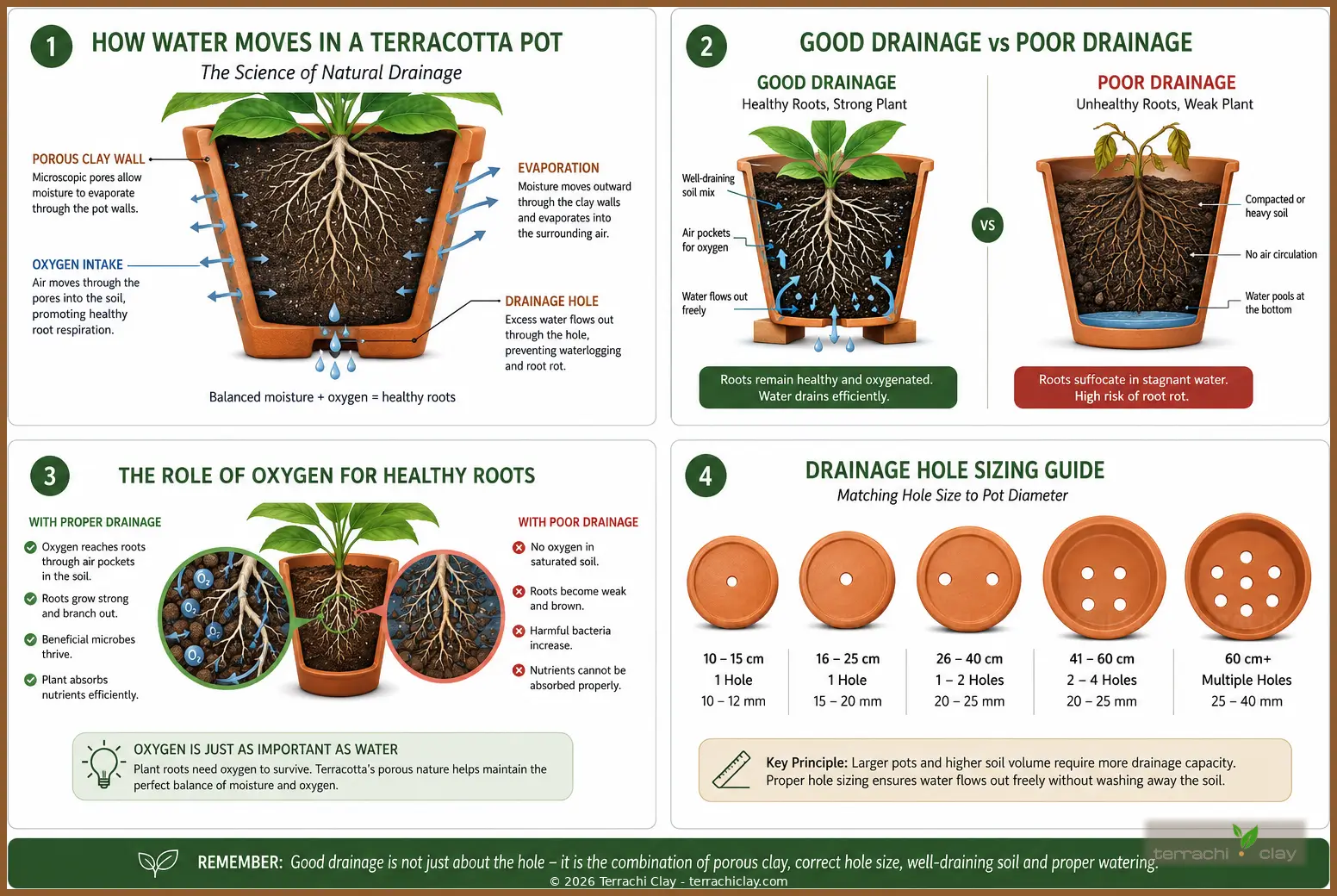
As the soil begins to dry, moisture slowly evaporates through the clay walls. This gradual movement helps prevent prolonged saturation while reducing the chance of stagnant conditions around the root system. The result is healthier roots, stronger growth and more consistent watering cycles.
Manufacturer Insight
The quality of the clay body, firing temperature and wall thickness directly influence drainage performance. High-quality terracotta maintains consistent porosity while retaining excellent structural strength.
Drainage Hole Engineering
Professional terracotta manufacturers design drainage holes according to planter diameter, soil volume and expected water flow. A drainage hole that is too small may restrict water movement, while an excessively large opening can reduce soil stability and increase media loss during watering.
| Pot Diameter | Recommended Drainage Hole | Typical Application |
|---|---|---|
| 10–15 cm | 1 hole (10–12 mm) | Succulents & Herbs |
| 16–25 cm | 1 hole (15–20 mm) | Indoor Plants |
| 26–40 cm | 1–2 holes (20–25 mm) | Medium Shrubs |
| 41–60 cm | 2–4 holes | Large Decorative Planters |
| 60 cm+ | Multiple engineered holes | Commercial Landscaping |
Terracotta vs Plastic: Drainage Comparison
Both materials can successfully grow healthy plants, but they manage moisture very differently. Understanding these differences helps gardeners choose the correct planter for each environment.
| Feature | Terracotta | Plastic |
|---|---|---|
| Wall Porosity | Excellent | None |
| Air Exchange | High | Minimal |
| Moisture Evaporation | Natural | Only through soil surface |
| Root Rot Risk | Lower | Higher if overwatered |
| Water Retention | Moderate | High |
| Best For | Mediterranean plants, herbs, succulents | Tropical plants requiring constant moisture |
Best Soil Mix for Terracotta Pots
Excellent drainage depends on both the container and the growing medium. Even the highest-quality terracotta planter cannot compensate for dense, compacted or poorly aerated soil. A well-balanced mix encourages rapid water movement while retaining sufficient moisture for healthy growth.
Recommended Ingredients
- High-quality potting soil
- Compost for nutrients
- Perlite for aeration
- Pumice or coarse sand
- Pine bark for structure
Avoid
- Heavy garden soil
- Clay-rich soil
- Compacted compost
- Fine construction sand
- Poorly draining media
How Often Should You Water Terracotta Pots?
Because terracotta allows moisture to evaporate through its walls, watering frequency depends on climate, pot size, plant species and soil composition. Small indoor planters may require watering every few days during warm weather, while large outdoor containers often benefit from deeper but less frequent watering.
Professional Tip
Rather than watering on a fixed schedule, check the top 2–3 cm of soil. Water thoroughly only when the upper layer becomes dry while the lower root zone still retains slight moisture.
Soil Volume Calculator
Calculate exactly how much soil your terracotta pot needs, plus get plant recommendations and bag counts. Proper soil volume ensures adequate drainage depth and prevents over-filling that can block drainage holes.
Indoor vs Outdoor Drainage Requirements
Drainage requirements change depending on where a terracotta planter is used. Indoor environments experience slower evaporation, while outdoor planters are exposed to rainfall, temperature fluctuations and seasonal weather. Selecting the correct drainage strategy improves plant health and extends the service life of the planter.
| Environment | Recommended Drainage Strategy |
|---|---|
| Indoor Plants | Single drainage hole with saucer. Empty standing water after watering. |
| Covered Balcony | Drainage hole with pot feet to improve airflow underneath. |
| Garden | Multiple drainage paths and elevated placement to avoid blocked drainage. |
| Commercial Landscape | Engineered drainage holes combined with coarse drainage layer and professional soil mix. |
10 Common Drainage Mistakes
- Using pots without drainage holes.
- Blocking drainage holes with decorative liners.
- Using dense garden soil inside containers.
- Overwatering on a fixed schedule.
- Allowing saucers to remain full of water.
- Choosing an oversized planter for a small plant.
- Ignoring seasonal watering adjustments.
- Placing outdoor pots directly onto concrete without airflow.
- Using damaged or cracked planters that restrict drainage performance.
- Ignoring early signs of root stress.
Manufacturer Knowledge: Why Terracotta Quality Controls Drainage
At Terrachi Clay, we manufacture terracotta planters using carefully selected natural clay, precision engineering, and controlled firing processes. The following technical details explain why our planters outperform lower-quality alternatives — and why understanding these factors matters for every gardener.
Why Firing Temperature Affects Porosity
The firing temperature is the single most important factor determining how well a terracotta pot drains. Terracotta is typically fired between Cone 04 and Cone 02 (approximately 1,945°F to 2,050°F). At this range, the clay body achieves optimal porosity of 6–11% — enough to allow moisture vapour to pass through the walls, but not so porous that the pot becomes structurally weak or excessively absorbent.
Firing below this range produces under-fired ware with porosity exceeding 15%, making the pot fragile and prone to waterlogging in the clay body itself. Firing above Cone 02 begins to vitrify the clay, reducing porosity below 4% and effectively sealing the walls — turning the pot into a non-breathing container similar to plastic. This is why cheap terracotta from uncontrolled kilns often fails to deliver the drainage benefits gardeners expect.
Why Wall Thickness Influences Moisture Regulation
Wall thickness directly controls the rate of moisture exchange between soil and atmosphere. At Terrachi Clay, we engineer wall thickness between 8 mm and 12 mm depending on planter size:
- Small pots (under 20 cm): 8–9 mm walls for faster drying — ideal for succulents and cacti.
- Medium pots (20–40 cm): 10–11 mm walls for balanced moisture retention — suitable for herbs, flowers, and indoor plants.
- Large pots (40 cm+): 11–12 mm walls for slower moisture loss — necessary for shrubs, trees, and commercial landscaping.
Thin walls (under 6 mm) dry too quickly and may crack under thermal stress. Thick walls (over 15 mm) reduce the beneficial porosity effect and make the planter unnecessarily heavy.
How Drainage Holes Are Engineered During Production
Drainage holes are not simply punched through the base after forming. At Terrachi Clay, they are engineered during the moulding stage with specific geometry:
- Hole diameter: Sized proportionally to pot diameter (10–12 mm for small pots, scaling to 20–25 mm for large planters).
- Hole placement: Positioned at the lowest point of the base profile to ensure complete water evacuation.
- Reinforced rim: Each drainage hole features a slightly raised, reinforced rim to prevent chipping and soil erosion around the opening.
- Multiple holes: Planters over 40 cm diameter receive 2–4 strategically placed holes to prevent single-point blockage.
Poorly engineered holes — too small, off-centre, or without reinforcement — are the leading cause of drainage failure in low-quality terracotta.
Quality Control for Commercial Terracotta Planters
Every Terrachi Clay planter undergoes three-stage quality control before leaving our facility:
- Stage 1 — Greenware Inspection: Check for cracks, warping, and uniform wall thickness before firing.
- Stage 2 — Porosity Testing: Sample pieces from each kiln batch are tested for water absorption. Acceptable range: 6–12% by weight.
- Stage 3 — Drainage Verification: Each planter is filled with water and observed for complete evacuation within 60 seconds. Any unit retaining water is rejected.
This process ensures that commercial buyers — garden centres, wholesalers, and landscape architects — receive consistent, predictable drainage performance across every batch.
Why This Matters for Your Plants
A planter that looks like terracotta but is fired too hot, too thin, or with poorly formed drainage holes will not provide the moisture regulation your plants need. Always purchase from manufacturers who publish their firing specifications and quality standards — or test a new pot by soaking it in water for 30 minutes. Genuine, well-made terracotta will absorb water and darken evenly. Under-fired or over-fired pots will show inconsistent colour change or no absorption at all.
How Professional Manufacturers Design Terracotta Pots
Professional terracotta manufacturers engineer every planter by balancing wall thickness, clay formulation, firing temperature and drainage design. High-quality production ensures that moisture leaves the container gradually without compromising structural integrity.
Manufacturing consistency is equally important. Uniform wall thickness helps produce predictable drying characteristics while maintaining sufficient mechanical strength for transportation, retail display and long-term outdoor use.
Terrachi Clay Manufacturing Philosophy
Every terracotta planter should provide a balance between durability, drainage efficiency and healthy root development. Proper engineering during production creates containers that perform consistently throughout their service life.
Terracotta Drainage Maintenance Checklist
| Maintenance Task | Frequency |
|---|---|
| Inspect drainage hole | Monthly |
| Flush accumulated salts | Every 3–6 months |
| Replace compacted soil | Annually |
| Inspect for cracks | Before each growing season |
| Clean algae and mineral deposits | As required |
Professional Recommendations
Frequently Asked Questions
The following questions address many of the most common topics raised by gardeners about terracotta pot drainage. Together they form a practical reference for choosing, using, and maintaining terracotta planters with optimal drainage.
Do all terracotta pots need drainage holes?
Yes. A drainage hole is essential for removing excess water and reducing the risk of root rot. Decorative planters without drainage should be used only as outer cachepots.
Can I put stones in the bottom of a terracotta pot?
Modern horticultural research generally recommends using a well-draining potting mix instead of adding gravel or stones, as they do not reliably improve drainage.
Why do terracotta pots dry out faster?
The porous clay walls allow moisture to evaporate naturally, improving oxygen exchange but also increasing watering frequency compared with plastic containers.
Which plants benefit most from terracotta?
Succulents, herbs, lavender, rosemary, citrus, olive trees and many Mediterranean species thrive in the excellent drainage conditions provided by terracotta.
How can I improve drainage in large outdoor planters?
Use engineered drainage holes, elevate the planter with pot feet, select a coarse potting mix and avoid compacted soils.
What firing temperature is best for terracotta planters?
The optimal firing range for terracotta planters is Cone 04 to Cone 02 (approximately 1,945°F to 2,050°F). This achieves 6–11% porosity for excellent moisture regulation while maintaining structural strength.
Looking for Premium Terracotta Planters?
Terrachi Clay manufactures high-quality terracotta pots and planters for garden centers, wholesalers, retailers and commercial landscaping projects worldwide. Every planter is produced using carefully selected natural clay and engineered for durability, healthy drainage and long-term performance.