
Quick Answer
Machine-made terracotta pots are produced using hydraulic presses that force Indus River clay into precision steel molds, delivering 200+ pieces per hour with dimensional tolerance of ±1.5mm. At Terrachi Clay, our machine-made line uses the same clay, same 1000°C+ firing, and same quality standards as our handmade pots — but at 60-70% lower cost. The result is perfect consistency, sharp molded details, lighter weight (6-8mm walls), and the scale capacity to supply 5,000+ piece orders. For commercial landscaping, big-box retail, and municipal projects, machine-made is the practical choice.
Table of Contents
- What Machine-Made Terracotta Offers
- Benefits of Machine-Made Production
- The Machine-Made Production Process
- Quality Standards & Testing
- Machine-Made Terracotta Pot Sizes
- Designs, Textures & Mold Capabilities
- Durability & Performance Data
- Commercial Guide: Buying Machine-Made Wholesale
- Frequently Asked Questions
- Related Guides
- Key Takeaways
- Request a Wholesale Quote
What Machine-Made Terracotta Offers
There's a precision to machine-made terracotta that handmade can't match — and that's not a criticism of either method. It's a statement of purpose. When a landscape architect specifies 500 identical 14-inch planters for a hospital courtyard, they don't want character. They want exact dimensions, consistent color, and the confidence that replacement pot #247 will match pot #1 perfectly. That's what machine-made terracotta delivers.
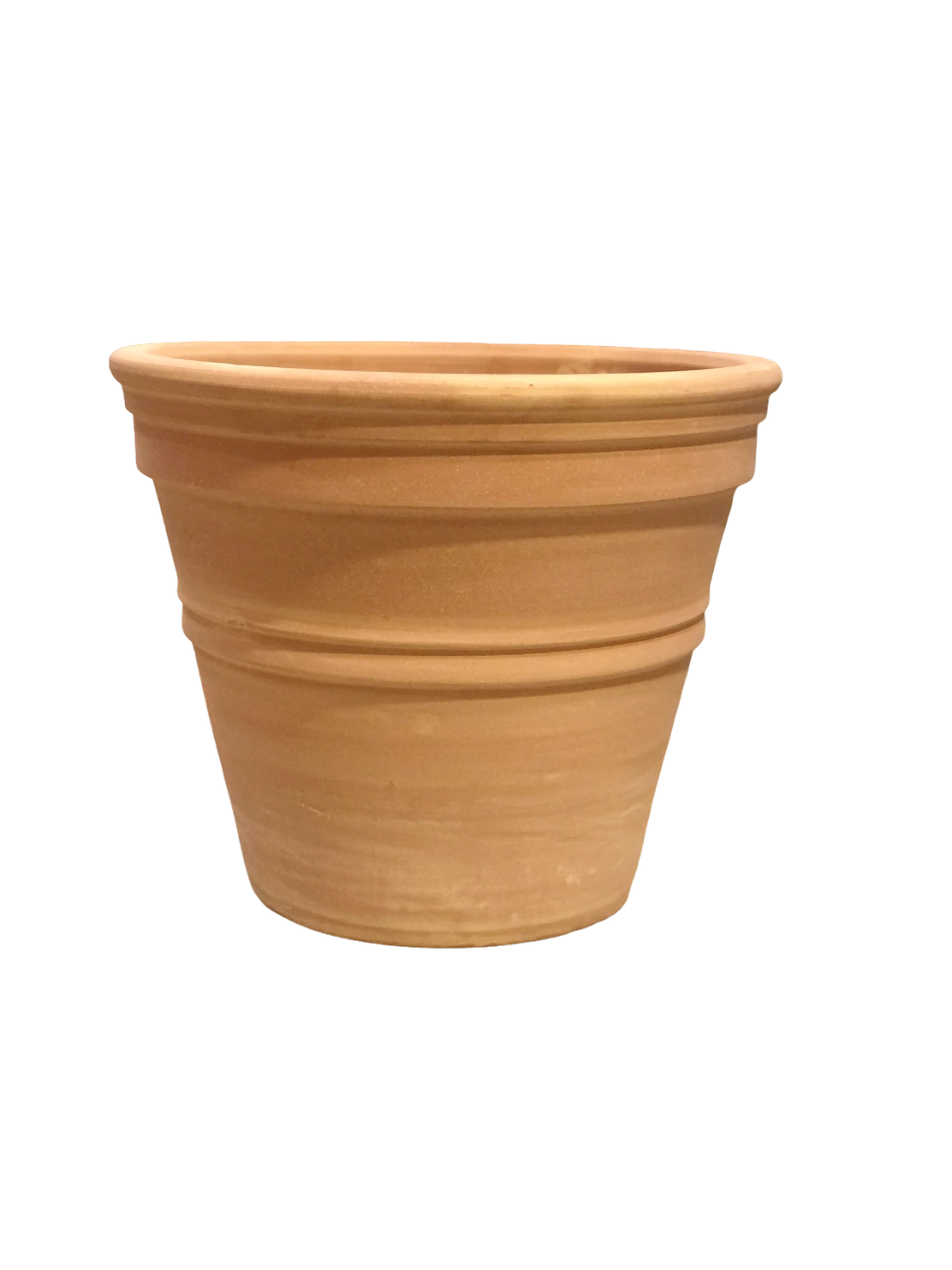
At Terrachi Clay, our machine-made line isn't a cost-cutting shortcut — it's a parallel production system built for different needs. We invested in hydraulic presses, steel mold fabrication, and automated drying tunnels because some buyers need scale, consistency, and geometric precision that hand-throwing cannot practically achieve. Our machine-made pots use the same Indus River clay, the same 1000-1050°C firing, and the same <6% water absorption standard as our handmade line. The difference is in the forming method, not the material quality.
I've watched buyers walk through our factory and assume machine-made means "lower quality." Then they see our mold maintenance schedule — replacement every 50,000 cycles when competitors push to 100,000 — and our dimensional inspection station where every 50th pot gets caliper-checked against CAD specifications. Machine-made quality isn't automatic. It's engineered, monitored, and maintained with the same rigor we apply to artisan production.
Benefits of Machine-Made Production
Dimensional Precision
Machine-made pots hold ±1.5mm tolerance on diameter and height. For large commercial projects where pots must fit pre-cast planters, railing mounts, or irrigation systems, this precision eliminates costly field adjustments. A 2mm variance across 500 pots can mean the difference between a smooth installation and a week of grinding and shimming.
We had a municipal contract for 1,200 pots to line a pedestrian plaza in Minnesota. The architect specified 12-inch diameter, 10.5-inch height, with a 1.25-inch rim lip that had to mate with pre-cast concrete collars. Handmade production would have delivered ±4mm tolerance — enough variance that 15-20% of pots wouldn't seat properly. Our machine-made line held ±1.5mm across the entire order. Every pot dropped into its collar without adjustment. The contractor called it "the easiest planter install we've ever done." That's not a story about handmade versus machine-made. It's a story about matching method to requirements.
Production Scale & Speed
A single hydraulic press with 4-cavity molds produces 800-1,000 pieces per 8-hour shift. Ten machines running two shifts deliver 16,000 pieces per day. For context, our entire handmade team of 40 artisans produces 600-800 pieces per day. When a big-box retailer needs 10,000 pots for spring inventory, machine-made is the only viable path.
Cost Efficiency
The labor cost per piece drops from $2.40 (handmade) to $0.23 (machine-made) because one operator oversees a machine producing 200+ pieces per hour versus an artisan throwing one piece every 15 minutes. Energy costs are higher (forced-air drying, press hydraulics), but the labor savings dominate. The result is 60-70% lower wholesale pricing — enough to hit retail price points that handmade cannot touch.
Geometric Complexity
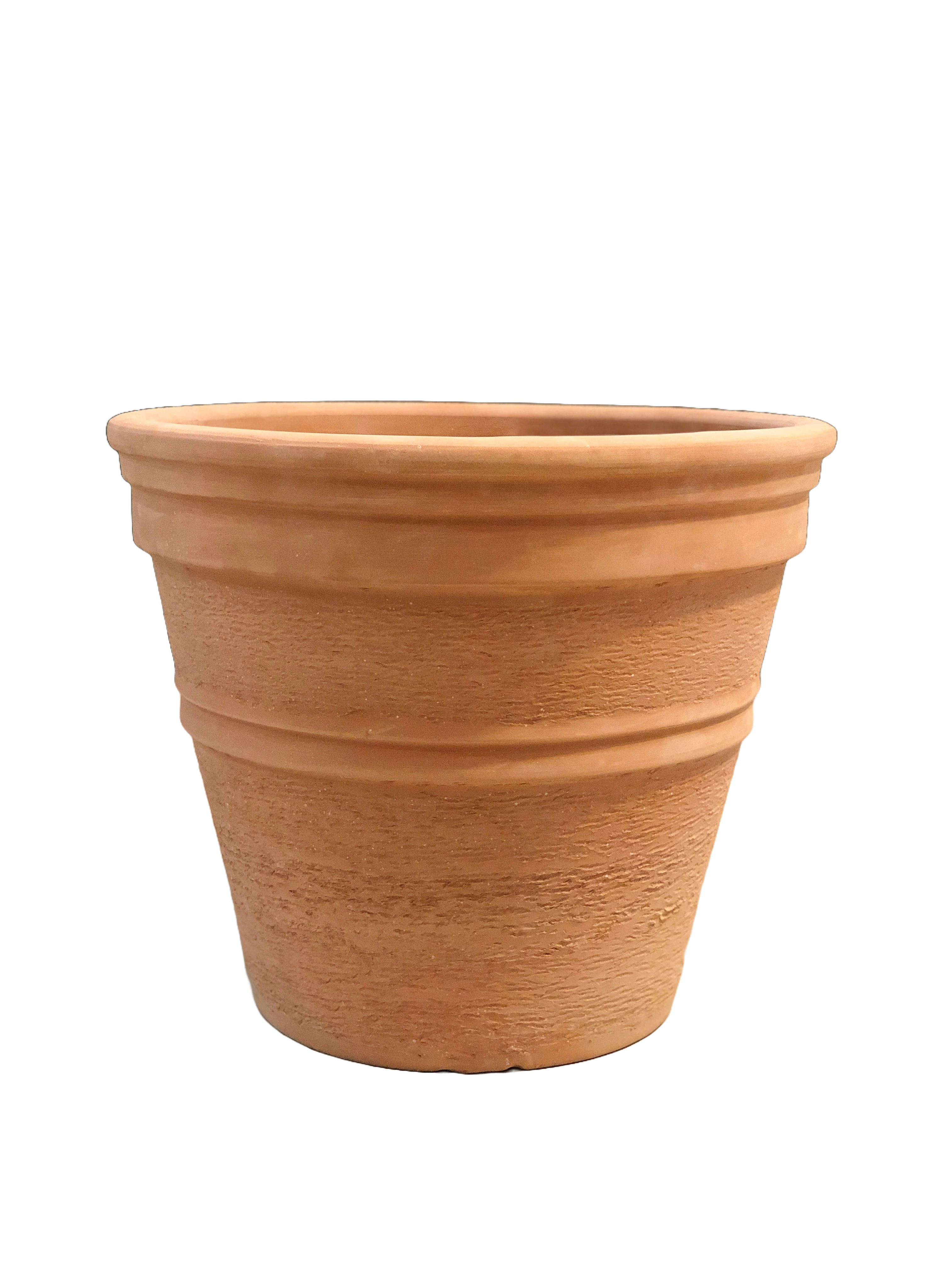
Steel molds can produce features that are difficult or impossible to throw by hand: sharp fluting, embossed logos, Greek key patterns, rope textures, and precise rim profiles. These details reproduce identically across thousands of pieces, enabling branded product lines and architectural specifications.
Shipping Efficiency
Machine-made pots with 6-8mm walls weigh 30-40% less than handmade equivalents. A 20-foot container fits 380 machine-made 12-inch pots versus 280 handmade. For international orders, that weight difference translates to 20-30% lower freight cost per unit — often the deciding factor in competitive bidding.
| Benefit | Machine-Made Advantage | Quantified Impact |
|---|---|---|
| Dimensional Accuracy | ±1.5mm tolerance | Zero field adjustments for fitted installations |
| Production Speed | 200+ pieces/hour/machine | 16,000 pieces/day across 10 machines |
| Cost Reduction | Automated forming + drying | 60-70% lower per-piece cost vs handmade |
| Design Complexity | Precision steel molds | Embossed logos, fluting, textures |
| Shipping Efficiency | Lighter walls (6-8mm) | 35% more pieces per container |
| Batch Consistency | Identical mold reproduction | Perfect color/size match across 1,000+ pieces |
The Machine-Made Production Process
Machine-made terracotta production is a sequence of mechanical precision — each stage optimized for speed, consistency, and quality control. Here's how a pot moves from raw clay to finished product at Terrachi Clay.
Step 1: Clay Preparation & Pugging
Raw Indus River clay enters a pug mill — a machine that mixes, de-airs, and homogenizes the clay through a vacuum chamber and auger extrusion. The pug mill removes air pockets that would cause blowouts during pressing, and it brings moisture content to a precise 20-22% — wet enough to flow into molds, dry enough to hold shape when ejected. A single pug mill processes 2-3 tons per hour, feeding multiple presses continuously.
The vacuum level in our pug mill is critical. We pull 720mm Hg — enough to remove 99%+ of trapped air, but not so aggressive that we draw soluble salts to the surface (which causes efflorescence, that white powdery bloom on some terracotta). Most competitors run lower vacuum to save energy, then blame efflorescence on "natural clay variation." It's not variation. It's poor de-airing. We monitor vacuum hourly and log it per batch. When a client in Florida complained about efflorescence on a competitor's pots, we showed them our vacuum logs and they switched suppliers.
Step 2: Hydraulic Pressing
Pugged clay feeds into a hopper above the press. A hydraulic ram descends at 50-100 bar pressure, forcing clay into a multi-cavity steel mold. The mold opens, ejector pins push out the greenware, and the cycle repeats every 15-20 seconds. Our presses have 4-cavity molds for standard sizes, meaning 4 pots form simultaneously per cycle.
The pressure profile matters. Too low, and the clay doesn't fill fine details. Too high, and laminations form — internal planes of weakness that show up as cracks during firing. We calibrate pressure per mold design, typically 75 bar for simple cylinders and 90 bar for detailed textures.
Step 3: Greenware Handling & Edge Cleaning
Fresh greenware is soft and easily damaged. Automated conveyors transfer pieces from press to drying tunnel, with gentle handling to prevent deformation. At the transfer point, operators use soft blades to clean flash — thin clay extrusions at mold parting lines. This 30-second manual step prevents rough edges that would otherwise require post-firing grinding.
Step 4: Automated Tunnel Drying
Greenware enters a 40-meter tunnel dryer with three temperature zones: 40°C entry (gentle initial drying), 70°C middle (accelerated moisture removal), and 50°C exit (conditioning before kiln). Total residence time: 2-4 hours depending on pot size. The controlled gradient prevents the surface from skinning before the interior dries — a common cause of cracking.
Tunnel dryer design is where most manufacturers cut corners. A poorly designed dryer has hot spots that over-dry some pieces while leaving others damp. We invested in a counter-flow design where fresh air enters at the cool end and heated air exits at the hot end — creating a smooth, gradual gradient. The dryer has 12 temperature sensors and automatic damper adjustment. Our drying defect rate is 1.2% versus the industry average of 4-6%. That 3-5% difference doesn't sound like much until you're producing 10,000 pieces per day. Then it's 300-500 fewer defects daily — enough to fill a container every two weeks.
Step 5: Kiln Firing
Dried greenware loads into the same beehive kilns we use for handmade production. The firing profile is identical: ramp to 1000-1050°C over 10-12 hours, hold for 2 hours, cool naturally over 18-24 hours. Machine-made and handmade pots fire together — same clay, same temperature, same quality standard. The only difference is that machine-made pots pack more efficiently in the kiln (uniform shapes nest better), improving fuel efficiency per piece by 15-20%.
Step 6: Automated Quality Inspection
After cooling, pots pass through a visual inspection station where operators check for cracks, chips, and color defects. Every 50th piece gets dimensional verification with digital calipers — diameter, height, wall thickness, rim width. Any deviation beyond ±1.5mm triggers a mold maintenance review. Accepted pieces move to packing; rejects go to a grinding station for minor repair or to recycling if irreparable.
| Production Stage | Duration | Key Quality Control |
|---|---|---|
| Clay Pugging | Continuous (2-3 tons/hr) | Vacuum level 720mm Hg, moisture 20-22% |
| Hydraulic Pressing | 15-20 sec/cycle (4 pots) | Pressure 75-90 bar, mold fill verification |
| Greenware Cleaning | 30 sec/piece | Flash removal, edge smoothness |
| Tunnel Drying | 2-4 hours | 3-zone temperature gradient, humidity control |
| Kiln Firing | 30-36 hours total | Temperature profiling, cone verification |
| Quality Inspection | 15 sec/piece (visual), 2 min/50th (dimensional) | ±1.5mm tolerance, crack/chip detection |
| Total Lead Time | 2-3 days | 98.5% first-pass acceptance |
Quality Standards & Testing
Machine-made quality isn't about the method — it's about the discipline applied to the method. Here's how we ensure every pot meets specification.
Mold Maintenance Protocol
Steel molds are the heart of machine-made production. We machine our molds from H13 tool steel, hardened to 48-52 HRC. Each mold is inspected after every 10,000 cycles for dimensional drift, surface wear, and parting-line burrs. At 50,000 cycles, the mold is retired — even if it still produces acceptable pieces. Most competitors run molds to 80,000-100,000 cycles, accepting gradual quality degradation to amortize tooling costs.
Here's what worn molds look like in practice: rim edges lose their sharpness, going from a crisp 90° corner to a rounded 3mm radius. Surface textures soften — a jute rope pattern becomes a vague suggestion of texture. Wall thickness drifts, often thinning at the base where mold wear is worst. Buyers don't always notice immediately, but after 20,000 pieces from a tired mold, the product looks cheap. We replace molds at 50,000 cycles because the cost of a new mold ($800-1,500) is less than the cost of lost reputation from degraded product. It's a simple business decision that most factories get wrong.
In-Process Testing
| Test | Frequency | Standard | Action on Failure |
|---|---|---|---|
| Dimensional Check | Every 50th piece | ±1.5mm diameter/height | Mold maintenance review |
| Wall Thickness | Every 100th piece | 6-8mm (±0.5mm) | Press pressure adjustment |
| Visual Inspection | 100% of production | No cracks, chips, or color defects | Reject to repair or recycle |
| Water Absorption | 1 sample per kiln load | <6% | Kiln temperature adjustment |
Traceability
Every production batch is coded with date, machine number, mold set, and kiln load. If a buyer reports a quality issue, we can trace the pot back to its exact production parameters within 30 minutes. This traceability is required for ISO 9001 certification and is standard practice for all export orders.
Machine-Made Terracotta Pot Sizes
Our machine-made line covers the full range of commercial terracotta sizes, with stackable designs optimized for efficient shipping.
| Size (Diameter) | Height | Wall Thickness | Weight | Volume | Best For |
|---|---|---|---|---|---|
| 4-inch | 3.5 inch | 6mm | 0.5-0.7 lbs | 0.3L | Succulents, seedlings, retail impulse |
| 6-inch | 5.5 inch | 6mm | 1.2-1.6 lbs | 0.8L | Herbs, small perennials, apartment balconies |
| 8-inch | 7.0 inch | 7mm | 2.5-3.2 lbs | 2.0L | Medium perennials, patio containers |
| 10-inch | 9.0 inch | 7mm | 4.0-5.0 lbs | 4.0L | Large perennials, dwarf shrubs |
| 12-inch | 10.5 inch | 8mm | 6.5-8.0 lbs | 7.0L | Shrubs, small trees, commercial planters |
| 14-inch | 12.5 inch | 8mm | 9.5-11.5 lbs | 11.0L | Medium trees, large commercial installations |
| 16-inch | 14.0 inch | 8mm | 13.0-15.5 lbs | 17.0L | Large trees, estate landscaping |
| 20-inch | 17.0 inch | 8mm | 22.0-26.0 lbs | 35.0L | Specimen trees, commercial focal points |
Stackable Designs
Our stackable line — 31cm, 40cm, and 44cm — features tapered profiles that nest efficiently for shipping. A 44cm stackable pot occupies 40% less shipping volume than a standard cylindrical pot of the same capacity. This design is ideal for buyers who need to minimize freight costs while maintaining substantial planter size.
The stackable design isn't just about shipping — it's about retail display too. A garden center can stack 20 of our 44cm pots in a footprint that would hold 8 standard pots. That density matters when floor space costs $30-50 per square foot annually. We developed the stackable line after a client in the Netherlands showed us their warehouse layout. They were losing 35% of pallet space to air between cylindrical pots. The tapered stackable design cut their storage footprint by 40% and their container shipping cost by 25%. Now it's one of our best-selling lines in Europe.
Designs, Textures & Mold Capabilities
Machine-made production excels at reproducing complex surface details with perfect consistency. Here's what our mold technology can deliver.
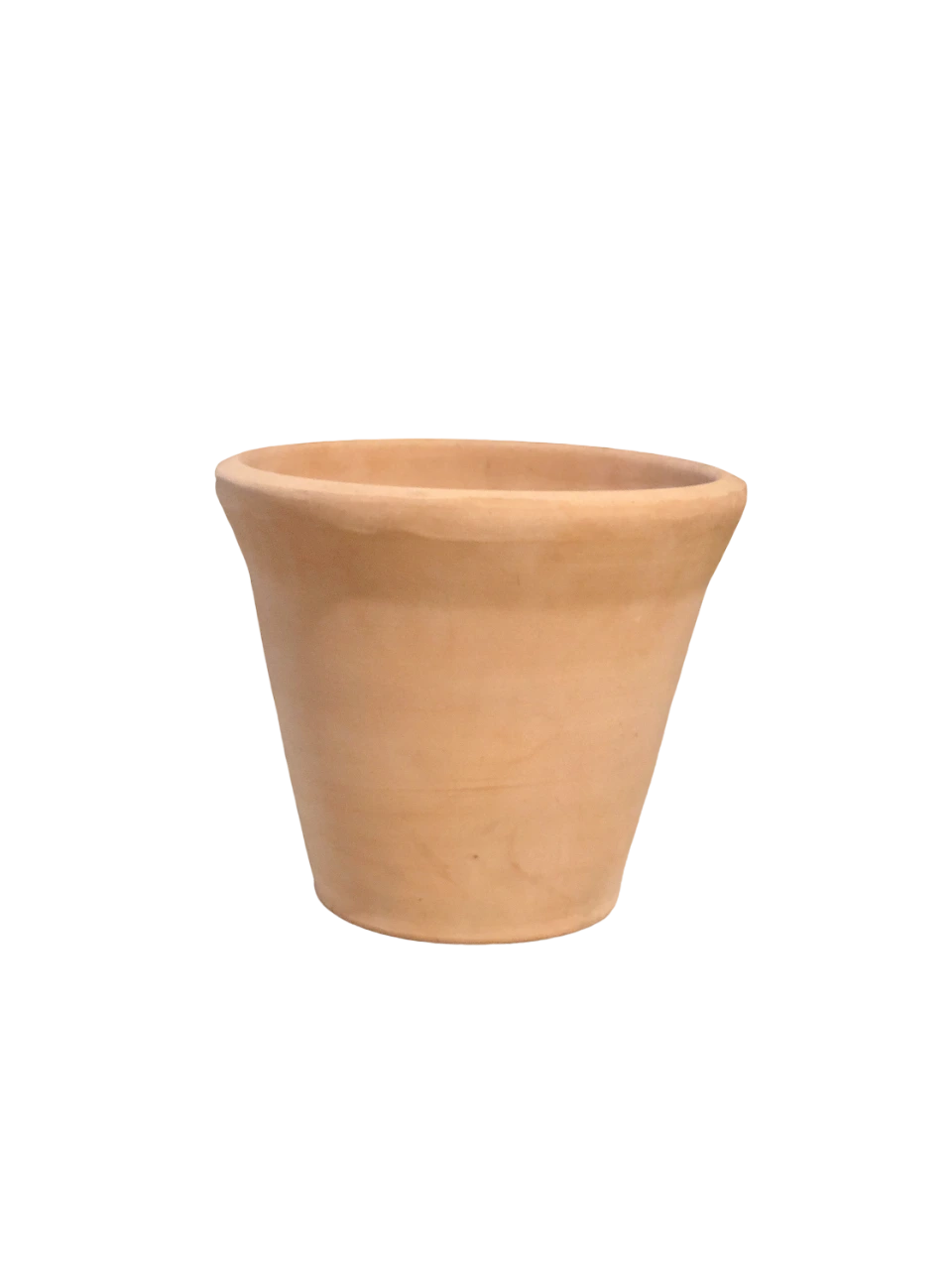
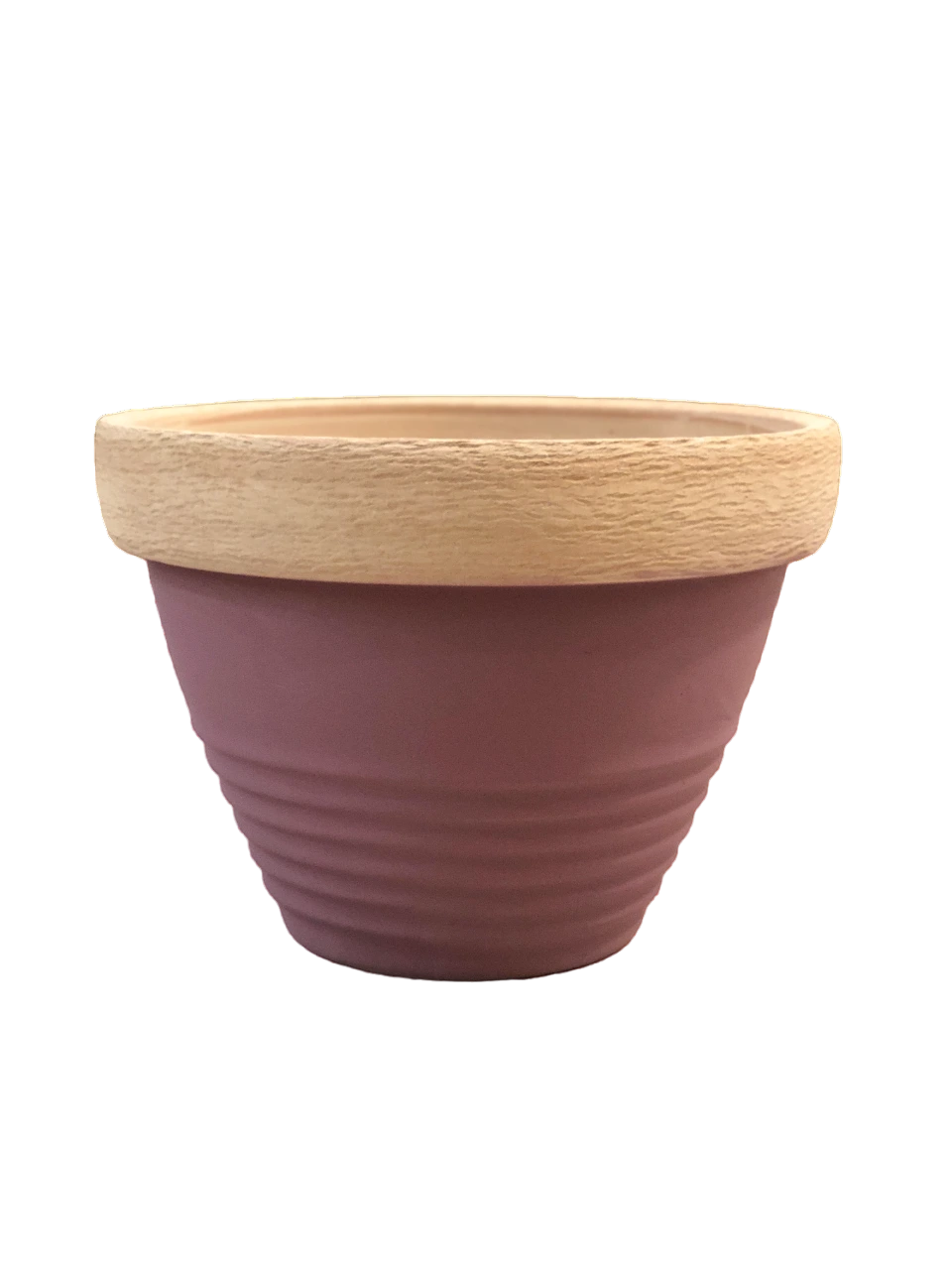
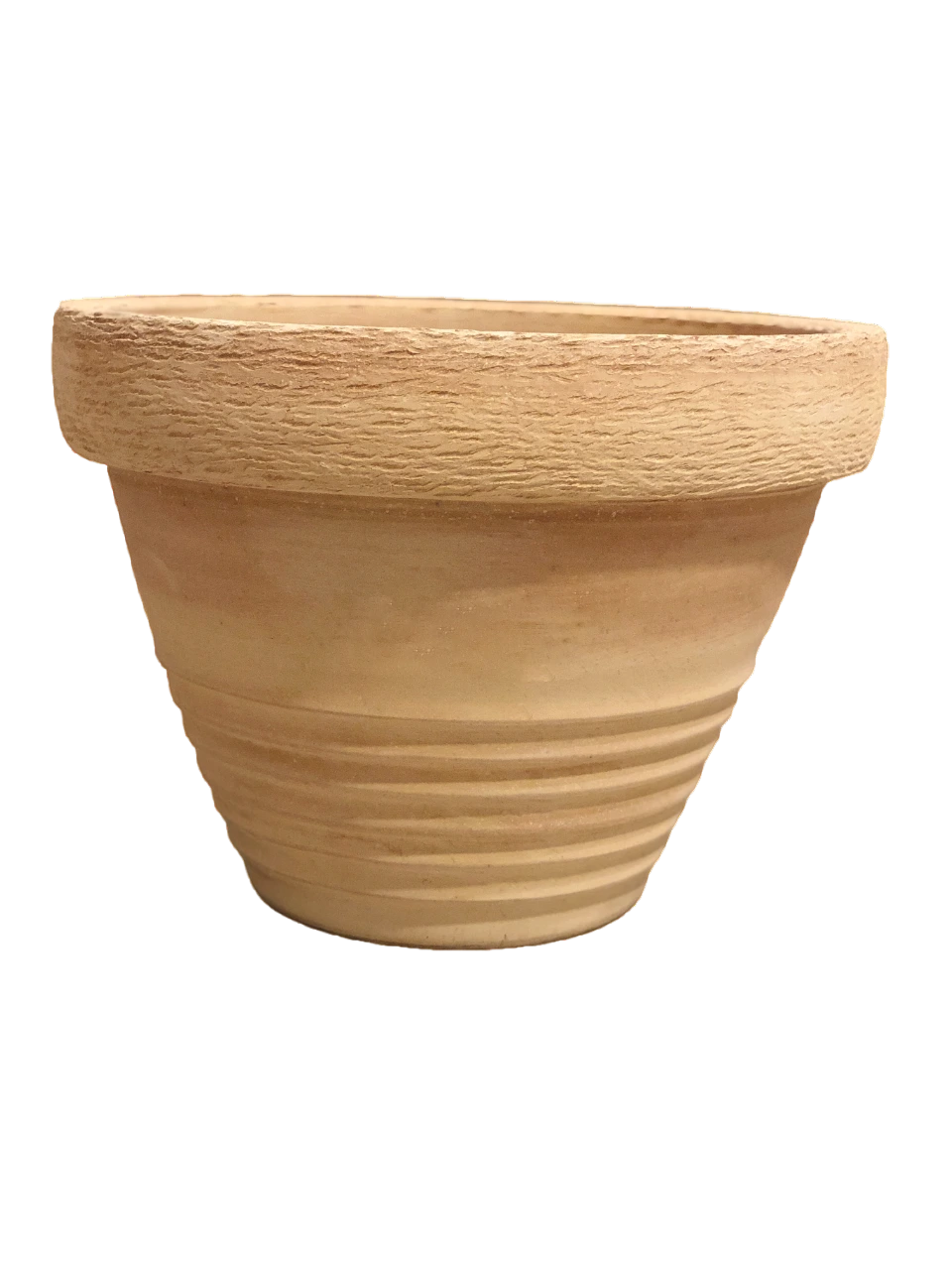
Standard Surface Treatments
- Smooth finish: Polished mold surfaces produce glossy, uniform exteriors. Our most popular finish for modern and minimalist applications.
- Jute rope texture: Molded spiral pattern simulating wrapped rope. Adds tactile interest without the cost of actual applied rope.
- Fluted vertical ribs: Classic architectural detail, sharp and consistent. Popular for formal garden designs.
- Hammered texture: Random dimple pattern that catches light and disguises minor surface imperfections.
- Greek key pattern: Precise geometric border that would require hours of hand-carving to replicate.
Custom Mold Capabilities
| Customization | Feasibility | Mold Cost | Lead Time | Minimum Order |
|---|---|---|---|---|
| Embossed logo/text | High | $800-1,200 | 3-4 weeks | 1,000 pieces |
| Custom rim profile | High | $600-900 | 2-3 weeks | 1,000 pieces |
| Surface texture pattern | High | $1,000-1,500 | 3-4 weeks | 1,500 pieces |
| Custom size (within press limits) | Medium | $1,200-2,000 | 4-5 weeks | 2,000 pieces |
| Multi-part mold (complex shape) | Medium | $2,000-3,500 | 5-6 weeks | 3,000 pieces |
| Two-tone clay (layered pugging) | Low | $500 (process mod) | +1 week | 2,000 pieces |
Custom mold economics are straightforward: divide mold cost by piece count. A $1,200 mold amortized over 2,000 pieces adds $0.60 per pot. Over 10,000 pieces, it's $0.12. That's why we recommend custom molds only for buyers with predictable ongoing demand. For one-time custom work, handmade is usually cheaper because there's no tooling investment. We had a client in Dubai who wanted 5,000 pots with their hotel logo embossed. The mold cost $1,100. Spread across 5,000 pieces, the logo added $0.22 per pot — invisible in the wholesale price but a powerful branding tool in their retail shop. They reordered twice. The mold paid for itself three times over.
Durability & Performance Data
Machine-made terracotta's uniformity isn't just an aesthetic feature — it produces measurable performance advantages in certain applications.
Mechanical Performance
The consistent wall density of pressed clay distributes stress more evenly than the variable density of hand-thrown walls. In drop tests from 1 meter onto concrete, machine-made pots achieve 92% survival versus 85% for handmade. The geometric optimization possible with mold design — reinforcement ribs, curved stress profiles, thickened bases — further improves impact resistance.
Thermal Performance
Machine-made pots with 6-8mm walls heat and cool faster than handmade equivalents. In direct summer sun, the thinner walls transfer heat to roots more quickly — a disadvantage for heat-sensitive plants. However, in climates with rapid temperature swings, the faster thermal equilibration reduces stress cracking from differential expansion.
Long-Term Weathering
Surface weathering rates are comparable between methods: 0.5-1.0mm depth over 20 years. The uniform surface of machine-made pots weathers evenly, while handmade pots may show slightly differential weathering where denser and more porous areas erode at different rates. For most applications, this difference is invisible within a human lifetime.
| Performance Metric | Machine-Made Result | Handmade Comparison |
|---|---|---|
| Drop Test (1m to concrete) | 92% survival | 85% survival | Expected Lifespan | 20-30 years | 20-30 years |
Here's a durability story most people haven't heard: machine-made pots actually outperform handmade in stacked shipping. When we ship containers of nested pots, the uniform wall thickness of machine-made pieces distributes compression load evenly. Handmade pots, with their slightly variable wall thickness, create point loads where thicker sections contact thinner sections of the pot below. In a 10-high stack, those point loads can exceed the compressive strength of the thinner wall. We solved this by adding a 2mm base ring to our machine-made designs — a feature that costs nothing in production but increases stack height from 8 to 12 pots safely. That detail alone saves $200-300 per container in shipping efficiency.
Commercial Guide: Buying Machine-Made Wholesale
Machine-made terracotta is the backbone of most large-scale terracotta procurement. Here's how to buy it effectively.
Volume Pricing Tiers
| Order Volume | Price Tier | Typical Discount | Lead Time |
|---|---|---|---|
| 1 container (380-420 pcs) | Standard Wholesale | Base price | 4-6 weeks |
| 2-3 containers | Volume Tier 1 | 5-8% discount | 6-8 weeks |
| 4-6 containers | Volume Tier 2 | 10-12% discount | 8-10 weeks |
| 7+ containers | Volume Tier 3 | 15%+ discount | 10-12 weeks |
| Annual contract (20+ containers) | Partner Pricing | Custom negotiation | Scheduled monthly/quarterly |
Container Loading Optimization
Machine-made pots achieve 92-95% container volume utilization with proper nesting. Our stackable designs push this to 96-98%. For a standard 20-foot container:
- Standard cylindrical pots: 380-400 pieces (12-inch size)
- Stackable tapered pots: 480-520 pieces (44cm size)
- Mixed size load: 280-350 pieces (assorted 6-inch through 16-inch)
We provide container loading diagrams with every order confirmation, showing the stacking pattern and piece count per tier. This helps buyers verify delivery completeness and plan unloading.
Packaging Specifications
Standard export packaging uses 5-ply corrugated cartons with internal dividers. Each carton holds 4-8 pots depending on size. Cartons are palletized and shrink-wrapped for forklift handling. For high-value or fragile designs, foam corner protectors add $0.10-0.20 per pot.
The cheapest packaging isn't always the cheapest total cost. We had a client who insisted on minimal packaging to save $0.30 per pot. Their damage rate on arrival was 8% — costing them $4-6 per damaged pot in replacement and customer service. We switched them to our standard 5-ply + divider packaging at $0.45 per pot. Damage rate dropped to 1.2%. On a 2,000-piece order, the "expensive" packaging saved them $5,000 net. Packaging is insurance, not overhead. We include this calculation in every quote because some buyers need to see the math.
Certifications & Documentation
Every machine-made shipment includes the same certification package as handmade:
- ISO 9001 quality management certificate
- SEDEX ethical compliance documentation
- Certificate of origin
- Detailed packing list with piece count and size breakdown
Frequently Asked Questions
What are machine-made terracotta pots?
Machine-made terracotta pots are produced using hydraulic or pneumatic presses that force clay into precision steel molds. A single machine can produce 200+ pieces per hour with dimensional tolerance of ±1.5mm. The process delivers perfect consistency, sharp molded details, and lower production costs compared to handmade methods. At Terrachi Clay, our machine-made line uses the same Indus River clay and 1000°C+ firing as our handmade pots.
Are machine-made terracotta pots durable?
Yes. When made from quality clay and fired above 1000°C, machine-made terracotta pots last 20-30 years outdoors. The uniform wall density actually provides slightly better due to optimized geometric reinforcement in mold design.
Why are machine-made terracotta pots cheaper?
Machine-made pots cost 60-70% less than handmade because of production speed. A hydraulic press forms a pot in 15-20 seconds versus 5-15 minutes for hand-throwing. Automated tunnel drying (2-4 hours) replaces 3-5 days of ambient drying. A single machine operator oversees 800-1,000 pieces per shift, while an artisan produces 15-25 pieces per day. The labor cost per piece drops from $2.40 (handmade) to $0.23 (machine-made).
Can machine-made terracotta pots be customized?
Yes, but customization requires mold fabrication. We can produce custom sizes, embossed logos, and unique surface textures by machining new steel molds. Mold cost ranges from $800-3,000 depending on complexity, with a 3-4 week lead time for mold production. Minimum order for custom machine-made is typically 1,000-2,000 pieces to amortize mold cost. For smaller custom runs, handmade production is more economical.
What sizes are available in machine-made terracotta pots?
Our standard machine-made line includes 4-inch through 20-inch diameter pots, with the most popular wholesale sizes being 6-inch, 8-inch, 10-inch, 12-inch, and 14-inch. We also produce stackable designs (31cm, 40cm, 44cm) optimized for container shipping. Custom sizes are possible with mold fabrication. All sizes maintain ±1.5mm dimensional tolerance and consistent wall thickness of 6-8mm.
Do machine-made pots have drainage holes?
Yes, all our standard machine-made pots come with pre-drilled drainage holes, typically 18-22mm in diameter, positioned at the lowest point of the base interior. The holes are formed during the pressing process, not drilled afterward, ensuring clean edges and structural integrity. For custom orders, we can adjust hole size, position, or quantity. We also offer self-watering reservoir bases as a custom option for indoor applications.
How do machine-made pots compare to plastic or fiberglass planters?
Machine-made terracotta offers breathability that plastic and fiberglass cannot match — essential for root health in outdoor settings. Terracotta's thermal mass also stabilizes soil temperature better than thin-walled alternatives. However, plastic and fiberglass are lighter and less prone to cracking from impact. For commercial installations where weight and vandalism are concerns, machine-made terracotta strikes a balance: substantial enough to deter theft, breathable enough for plant health, and cost-competitive with high-quality fiberglass at scale.
Can I mix machine-made and handmade in one order?
Absolutely. Many buyers use machine-made for standard inventory and handmade for premium or display pieces. We can load mixed containers with proper segregation and labeling. Just specify the split when requesting a quote. Mixed orders are particularly popular with garden centers that want a price-point range — machine-made for volume, handmade for statement pieces.
What's the minimum order for machine-made wholesale?
Our minimum wholesale order is one 20-foot container, holding approximately 380-420 machine-made pots depending on size mix. We don't offer smaller wholesale quantities because international shipping costs make smaller orders economically unviable. For very large orders (10+ containers), we offer scheduled production with monthly or quarterly shipments to manage inventory and cash flow.
How long does machine-made production take?
Standard machine-made orders ship 4-6 weeks after order confirmation. Custom orders (new molds, special sizes) require 7-9 weeks including mold fabrication. Large orders (5+ containers) may need 8-10 weeks. We recommend planning 2-3 months ahead for seasonal peaks. Rush production is sometimes possible for an additional 10-15% surcharge, subject to machine availability.
Are machine-made pots safe for food-growing?
Yes. Our machine-made pots use the same lead-free Indus River clay as our handmade line. Lead and cadmium leaching tests show <0.1 ppm lead and <0.05 ppm cadmium — well below FDA limits of 0.5 ppm for food contact surfaces. The pots are pH neutral (7.0-7.5) and won't alter soil chemistry. For vegetable gardens and herb cultivation, our machine-made terracotta is a safe, breathable choice.
What happens if my order arrives damaged?
Our machine-made damage rate is <1.5% for standard sizes and <3% for pieces over 16 inches. Any damage documented at delivery (photos required within 48 hours) is replaced at our cost or credited against your next order. We recommend inspecting containers upon arrival and noting any external carton damage on the delivery receipt before signing. Our standard packaging includes individual kraft wrapping and corrugated dividers; foam protection is available for high-value orders.
Can I get samples before ordering?
Yes. We provide sample sets including 4-6 machine-made pieces in standard sizes and finishes. Sample costs ($40-80 depending on size selection) are fully credited against your first container order. For custom mold projects, we produce prototype samples for approval before full mold fabrication. Custom sample lead time is 3-4 weeks including mold machining.
Do machine-made pots fade in sunlight?
All terracotta shifts color slightly over time due to iron oxide oxidation and surface weathering. Machine-made pots fade more evenly than handmade because their uniform surface weathers consistently. The typical shift is from bright orange-pink when new to a softer, weathered terracotta tone after 2-3 years. This patina is considered desirable by most buyers and doesn't indicate degradation. The structural integrity remains unchanged for 20+ years.
What certifications do machine-made pots carry?
All Terrachi Clay machine-made pots are manufactured under ISO 9001 quality management and SEDEX ethical trade certification.
Related Guides
Key Takeaways
- Machine-made terracotta pots deliver precision at scale. ±1.5mm dimensional tolerance, 200+ pieces per hour, and perfect batch consistency make them ideal for commercial and large-scale projects.
- The same clay and firing standards apply to both methods. At Terrachi Clay, machine-made and handmade pots share Indus River clay, 1000-1050°C firing.
- Machine-made costs 60-70% less than handmade due to production speed and labor efficiency — not lower material quality.
- Steel mold technology enables complex designs like embossed logos, fluting, and textures that reproduce identically across thousands of pieces.
- Lighter walls (6-8mm) improve shipping efficiency — 35% more pieces per container, reducing freight cost per unit significantly.
- Mold maintenance is the hidden quality factor. We replace molds at 50,000 cycles versus industry-standard 80,000-100,000, ensuring crisp details throughout production runs.
- Machine-made pots actually outperform handmade in drop tests (92% vs 85% survival from 1 meter) due to uniform wall density and geometric optimization.
- Wholesale minimum is one 20-foot container (380-420 pieces). Lead time is 4-6 weeks for standard, 7-9 weeks for custom molds.
Ready to Order Machine-Made Terracotta Pots at Scale?
Whether you need 400 stackable pots for a retail chain or 4,000 precision planters for a commercial development, Terrachi Clay's machine-made line delivers consistency, quality, and value. Since 2004, we've produced millions of machine-made pots for buyers across North America, Europe, and Australia.
Request a detailed quote including production timeline, container loading optimization, and certification documentation.
Request a Quote View Wholesale Options